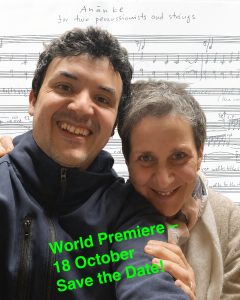
Anánke
2026, op. 114
Instrumentation: Two percussionists and string quintet or small string orchestra
Duration: ca. 16 min.
Commissioned by the Bavarian State Opera
World Premiere: 18 October 2026, Allerheiligen-Hofkirche, Munich
Chamber Ensemble of the Bavarian State Opera
Carlos Vera Larrucea: Percussion I
Tido Frobeen: Percussion II
So-Young Kim: Violin I
Julia Pfister: Violin II
Johanna Maurer: Viola
Barna Károly: Violoncello
Blai Gumi Roca: Double Bass
Composers Note
Anánke (Ἀνάγκη), the Greek goddess of necessity, represents the inevitable – those forces that lie beyond human will and yet shape life. She is one of the oldest and most mysterious figures in Greek mythology. In Plato’s Politeia, she appears as a cosmic power whose spindle sustains the order of the universe, around which the celestial spheres revolve. Even the Moirai, the goddesses of fate, are subject to her. Anánke embodies the order underlying all becoming and passing away – a necessity in which freedom and fate are paradoxically intertwined.
At the centre of my inner musical necessity stood silence: the silence before the beginning of composing or performing, the silence conveyed to us by the concert space, as well as the inner silence associated with interpretative freedom, supporting the performers in experiencing the individuality of their musical Gestaltung intensely, emerging from the meaning of silence.
The questions that arose through Anánke became the starting point for this composition: What do I experience as necessary in music and in its performance today? How can thoughts of necessity be expressed through music and translated into a compositional process of transformation? How can sonic connections emerge through the paradoxical and the unusual? How can independent soloistic tasks unfold their expressive power through contrapuntal communication, strengthen one another, and at the same time allow the listener to perceive themselves as part of the space? How can the concert space itself participate and, at the same time, shape the effect of collective music-making on the course and development of the sound? How can this give rise, each time, to a unique atmosphere that is at the same time sustained by the freedom of the moment?
The compositional process led me to develop a dramaturgy of five episodes, connected to one another as a coherent whole. They are linked through a predetermined choreography and make extensive use of the performance space as a stage. The concert stage thus becomes the place of the first shared musical encounter.
Beginning from silence, the sonic space gradually opens, and the performers are
progressively drawn into the shared musical process over the course of the five episodes. The individual players enter one after another, assuming their own contrapuntal roles, providing impulses and developing a lively dialogue together with the other members of the ensemble.
In the first and second episodes, soloistic musical narratives unfold throughout the space and in movement, increasingly taking on the character of signals leading towards the emergence of a dialogue, while also drawing on the spontaneity of the moment, on action and reaction. In the third episode, all members of the ensemble come together on stage to perform a dance that initially sounds archaic, like a ritual, and later develops into an impulsive process with changing metres. In the fourth and fifth episodes, an atmosphere of resonance and after-sound emerges, as though a magical sonic reality were continuing to exist, preparing the way for another kind of silence.
In this way, each voice initially contributes individually, with its own expressive necessity, to the unfolding of the shared sonic process and to the development of the ensemble sound. The entire process is driven by the desire to use music to open the senses of the listeners to an engagement with the question of what necessity means today (Anánke).